




Property Taxes on the Costa Blanca: 7 Things Buyers Should Know Before They Purchase
The price on the property listing is only the beginning.
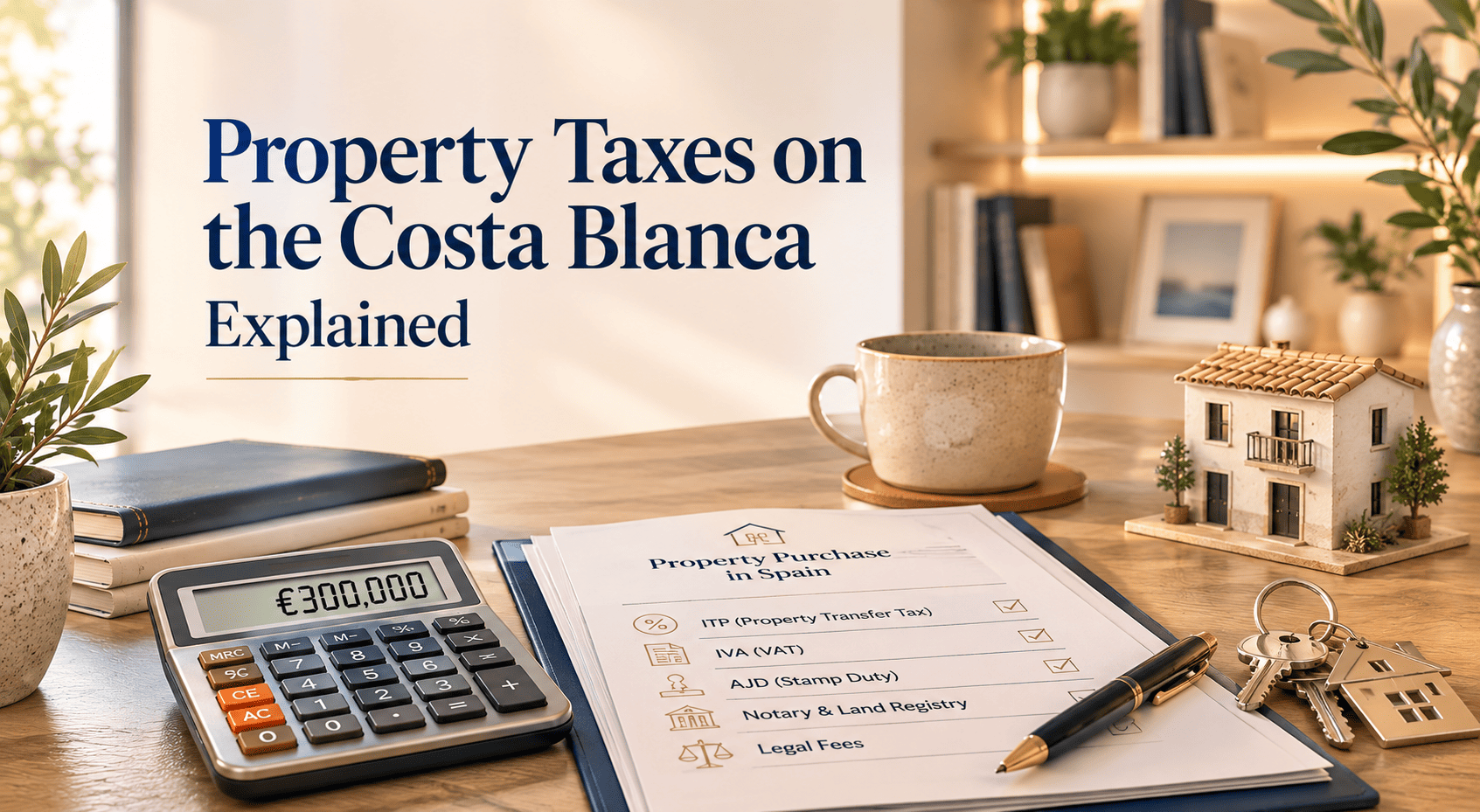
A €300,000 resale apartment and a €300,000 new-build home can come with very different tax bills. The final amount may also depend on the property's official tax value, its municipality and what you plan to do with it — live there, rent it out or use it as a second home.
If you're planning a move or retirement in Costa Blanca South, our team has prepared seven property-tax details to understand before you sign on the dotted line.
1. The property price isn't the whole story
When you see a property advertised for €250,000, it is natural to think:
“I have €250,000 available, so I can buy a €250,000 property.”
Not necessarily.
You also need to account for the taxes and costs associated with the purchase.
The exact amount depends on several factors, including:
Whether the property is new build or resale
Where the property is located
The value used for tax purposes
Whether you are buying with or without a mortgage
Your individual circumstances
Any special tax provisions that may apply
This is why we recommend working backwards from your total available budget, rather than simply choosing a property at the maximum of your purchase-price budget.
For example, imagine you're a retired couple from the Netherlands with €300,000 set aside for your move to Spain. You might have enough for a €300,000 property on paper, but using every euro on the purchase could leave little for furnishing your new home, a car, moving costs or an emergency fund.
That distinction is particularly important for retirees, because you may want to keep part of your savings available for the things that make your new life in Spain comfortable: furnishing the house, helping visiting family with travel, replacing a car or simply keeping a healthy financial cushion.
The goal isn't just to afford the property. It's to afford the life you want after buying it.
2. The type of property you buy affects the tax you pay
This is one of the first questions we ask when helping buyers calculate their budget.
There is an important difference between buying a resale property and buying a new-build property directly from a developer.
Resale property
For a typical resale property, the buyer generally pays Impuesto sobre Transmisiones Patrimoniales (ITP) — commonly translated as Property Transfer Tax.
As of 1 June 2026, the general ITP rate in the Valencian Community is 9% for property values up to €1 million. For properties with a value above €1 million, the general rate is 11%. There are also reduced rates and special provisions for certain buyers and transactions, so the general rate is not necessarily the rate that applies to everyone.
For a European retiree buying a typical resale apartment or villa in Costa Blanca South, the 9% general rate is therefore a useful starting point for budgeting — but the final calculation should be checked against the property's taxable value and your circumstances.
New-build property
When you purchase a qualifying new-build home from a developer, the tax structure is different.
Instead of ITP, the purchase generally involves:
IVA (VAT), and
AJD (Stamp Duty / Tax on Documented Legal Acts).
The standard VAT rate applicable to new residential properties is generally 10%. Meanwhile, the general AJD rate in the Valencian Community is 1.4%. A lower 0.1% rate applies in certain cases, including qualifying deeds documenting the acquisition of a habitual residence, so this should be checked for the specific buyer and transaction.
The key point isn't to memorise every acronym.
It is this:
Two properties with exactly the same asking price can have different purchase-tax bills simply because one is a resale and the other is a new build.
This is why a property search should always consider the total acquisition cost, not just the advertised price.
3. Don't assume the tax is simply calculated from the price you negotiated
This is one of the details that can easily be overlooked when buying property in Costa Blanca.
It is tempting to think that if you negotiate a property from €280,000 down to €260,000, every tax connected with the purchase will automatically be calculated on €260,000.
The reality can be more complicated.
For certain property taxes, the tax administration can take account of the property's reference value and other legally relevant valuation rules. The amount used for tax purposes therefore needs to be checked rather than assumed.
This is particularly important when you find what looks like a bargain.
A low purchase price can be excellent news. But don't calculate your entire tax bill simply by multiplying your negotiated price by a percentage without checking the applicable tax base.
Our advice?
Before committing to a purchase, ask: “What value will my purchase tax be calculated on?”
That is a much more useful question than simply asking: “What percentage is the tax?”
4. Property taxes can change — and old information is easy to find online
If you have been researching buying property in Spain for a while, you may already have found several different answers about how much tax you will pay.
That's not necessarily because someone is wrong.
Tax rules change.
And Spain's property taxes are not governed by one single national rate for every situation. Regional legislation can affect important aspects of property taxation.
For buyers looking at Costa Blanca South, the The Government of the Valencian Community (Generalitat Valenciana) is the key jurisdiction for the regional purchase taxes discussed above.
There have also been recent changes to Valencian tax legislation, making it particularly important to check that figures found in older blog posts or forum discussions are still current.
So if you find an article saying: “Property purchase tax in Spain is X%”
don't automatically use that figure to calculate the cost of your Costa Blanca home.
Check:
When the information was published
Where in Spain it applies
Whether it refers to a new build or resale
Whether the figure is still current
A tax article from three years ago isn't necessarily a reliable calculator for a purchase you're making today. That's why we regularly review and update our database, so you have access to the most up-to-date information when planning your purchase.
5. Costa Blanca South is not one single municipality
This may sound obvious, but it matters when you're buying property here.
“Costa Blanca South” is a convenient name for a property market, not a single local authority.
The area covers numerous towns, urbanisations and municipalities, each with its own local administration.
E-Style Spain is based in Punta Prima, in the Torrevieja/Orihuela Costa area, and works across many of the best-known residential areas of Costa Blanca South, including Punta Prima, Playa Flamenca, La Zenia, Villamartín, Campoamor, and Cabo Roig.
This local knowledge becomes particularly useful when you move beyond the one-off taxes you pay when purchasing.
For example: annual property tax
Most property owners in Spain are familiar with IBI (Impuesto sobre Bienes Inmuebles), the local property tax.
IBI is an ongoing ownership cost rather than a purchase tax.
The amount isn't simply a fixed percentage of the asking price. It is linked to the property's cadastral value and the applicable municipal rules. This means two homes that look similar on a property portal (and even have similar purchase prices) can have different annual IBI bills.
If you are comparing two homes for retirement, ask about the annual IBI for each one.
It is a small detail during a viewing, but a useful part of understanding the long-term cost of owning the property.
6. Property taxes don't necessarily end when you get the keys
When people search for “property taxes on the Costa Blanca”, they are often thinking about the taxes they pay when buying.
But if you are planning to retire or spend significant time in Spain, you should also think about the taxes and property-related costs that may apply after completion.
These can include:
IBI
As mentioned above, IBI is the local property tax paid by property owners.
Taxes affecting non-resident owners
If you remain tax resident in another European country and own a property in Spain, there can be Spanish tax obligations even if you do not rent the property.
The rules depend on your circumstances, including your tax residence and how the property is used.
Rental income
If you decide to rent out your property, additional tax considerations can arise around rental income.
The treatment can depend on your tax residency and other circumstances.
Your home as part of your wider financial situation
For retirees, buying a property abroad is rarely just a property decision. You may be moving savings, receiving a pension from another country, keeping assets elsewhere in Europe and potentially splitting your time between countries.
That is why we recommend treating property taxation as one part of your overall financial planning rather than trying to make a purchase decision from a single percentage found online.
For personal tax advice, always consult a qualified professional who can consider your individual circumstances.
7. The most useful property-tax figure is the one for the home you're actually buying
This is perhaps the most important point of all. There is no substitute for calculating the costs of the specific property you are considering.
A general guide can tell you what taxes exist and help you understand the terminology. But once you have found a property you are seriously considering, you want to know:
Which purchase tax applies?
What is the relevant tax base?
How much should I budget for the tax?
What other purchase costs should I allow for?
What is the property's current annual IBI?
Are there any circumstances specific to this property that I should investigate?
If I'm buying a new build, what exactly is included in the developer's advertised price?
These are much more useful questions than simply asking: “How much are property taxes in Costa Blanca?”
Because the answer you need isn't the Spanish average. It's the answer for your property.
A simple property-tax checklist for Costa Blanca buyers
Before you make an offer, we recommend having these figures clear:
When buying
☐ Purchase price
☐ Applicable purchase tax
☐ Notary and Land Registry costs
☐ Legal fees
☐ Mortgage-related costs, if applicable
☐ Any other transaction-specific expenses
After buying
☐ Annual IBI
☐ Community fees, if the property is part of a community
☐ Insurance
☐ Utilities
☐ Any relevant Spanish tax obligations based on your residency and use of the property
You don't necessarily need to know every number on the first day you start looking. But you should know them before you commit to the purchase.
Buying a property on the Costa Blanca? Let's look at the numbers together
Buying a home in Spain should feel exciting — not like a spreadsheet exercise.
But understanding the numbers before you buy gives you something even more valuable: confidence.
At E-Style Spain, we help international buyers find both resale and new-build properties throughout Costa Blanca South. With more than 20 years of local experience, our team can help you understand the practical aspects of buying a property and put you in touch with the appropriate professionals for legal and tax advice.
If you've already found a property you're interested in, you don't have to work everything out alone.
Book a free consultation with our experts to receive a personalised estimate of the buying costs you should budget for.
Frequently Asked Questions About Property Taxes on the Costa Blanca
What property taxes do you pay when buying a home on the Costa Blanca?
For a typical resale property, the buyer pays ITP (Property Transfer Tax). For a qualifying new-build property purchased from a developer, VAT (IVA) and AJD generally apply. The exact amount depends on the property and current Valencian Community rules.
Is property tax the same across Spain?
No. Some property taxes are affected by regional or municipal rules. For a property in Costa Blanca South, you should check the rules applicable in the Valencian Community and the relevant municipality.
Do foreigners pay different property purchase taxes?
Being a foreign buyer does not automatically mean you pay a higher purchase-tax rate. However, your tax residency and personal circumstances can affect other Spanish tax obligations, particularly once you own the property.
What is IBI?
IBI is the Spanish local property tax paid by property owners. It is an ongoing ownership tax, rather than a one-off purchase tax. The amount depends on factors including the property's cadastral value and the municipality.
Do I have to pay tax every year if I don't live in Spain?
Potentially, yes. Non-resident property owners can have Spanish tax obligations even when a property is not rented. The exact treatment depends on individual circumstances, so professional tax advice is recommended.
Should I calculate property taxes from the asking price?
Not necessarily. Depending on the tax involved, the legally relevant tax base may not simply be the price shown in the property advertisement or the final negotiated price. This should be checked for the specific transaction.
How much should I budget for property taxes when buying in Costa Blanca South?
There is no single budget that applies to every purchase. The property type, purchase price, applicable tax base and current Valencian rules all matter. The safest approach is to calculate the costs for the specific property before making an offer.
Can E-Style Spain help me calculate the costs of buying a property?
Yes. E-Style Spain works with both new-build and resale properties across Costa Blanca South and can help you understand the purchase process and the costs you should investigate before proceeding. Contact us for a personalised guidance on the property purchase and taxes.
Share