





Buying Property in Costa Blanca? Here's the Paperwork You'll Need at Every Stage
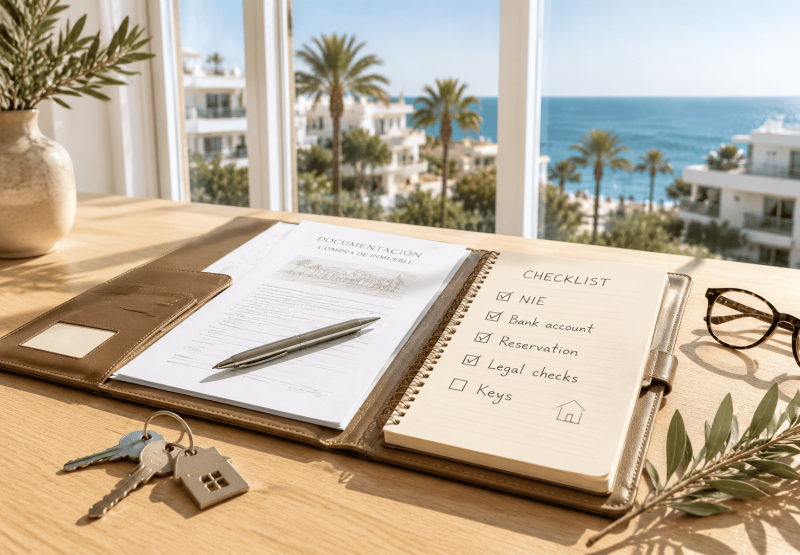
Retiring to the Costa Blanca is, for many EU citizens, a long-held plan finally coming together. Ask anyone who's already made the move what nearly put them off, though, and the answer is rarely the property itself — it's the paperwork.
That worry is largely unnecessary. As an EU citizen, you already have the two biggest advantages: the right to buy property in Spain with no special authorisation, and the right to live here without needing a visa. What remains is a well-defined process. Tackled in the right order, much of it can be organised before you've even chosen a property.
On the Costa Blanca, many overseas buyers only visit for a few days at a time to view properties before returning home. Because of this, preparing your paperwork early can make the difference between securing the right home quickly and watching someone else reserve it first.
This guide walks EU citizens through exactly what to prepare, when you'll need it, and what usually happens between your first viewing and collecting the keys.
Timeline at a Glance
Stage | Typical timing |
NIE number | 1–4 weeks (longer without a booked appointment) |
Spanish bank account | Same day to 1 week |
Property reservation | As soon as you find the right home |
Legal checks & completion prep | 4–8 weeks |
Post-completion registration & set-up | 4–8 weeks (runs in the background) |
Off-plan purchases follow a longer schedule tied to construction. This table gives a realistic sense of what to expect for a resale.
Step 1: Get Your NIE Number
Your NIE (Número de Identidad de Extranjero) is a personal ID number issued to foreigners for any legal or financial dealing in Spain: the bank account, the purchase itself, everything downstream depends on it, per Spain's Ministry of the Interior. It's not a residency permit, just an identifying number.
Apply as soon as you've decided you're serious about buying, don't wait until you've found the perfect property. You can apply in Spain at a police station or foreigners' office, or from home via a Spanish consulate. The number itself is issued relatively quickly once your appointment takes place. The biggest delay is often securing the appointment.
Most buyers on the Costa Blanca apply for their NIE before or shortly after arranging a viewing trip. That way, if they find the right property, they're already well ahead in the process.
If you're buying jointly with a spouse or partner, note that each of you needs your own NIE (one does not cover both names on the deed).
The good news is that you don't need the NIE to start viewing properties or even reserve one. It simply needs to be in place before completion, so it's best treated as something to organise alongside your property search rather than after it.
Advice from the E-Style Spain Team
From our experience, one of the most common mistakes European buyers make is waiting until you arrive in Spain to apply for your NIE. If you start the process in advance, you’ll have much more flexibility when the property you’re really interested in becomes available.
Step 2: Open a Spanish Bank Account
Not legally mandatory, but strongly recommended. Banks typically ask for your passport, NIE, proof of address, and evidence of your income or funds, although requirements vary slightly between banks. Many buyers wait until they've chosen a property, but opening an account a little earlier often helps avoid last-minute administration before completion.
Once you own your Costa Blanca home, this account becomes the hub for almost everything — utilities, community fees, local taxes and other regular payments are usually collected by direct debit.
Step 3: Reserve the Property and Appoint a Solicitor
Once you've found the right home, the pace often speeds up considerably. Well-priced properties in sought-after areas such as Punta Prima, Playa Flamenca and La Zenia don't always stay on the market for long, so buyers are often asked to sign a reservation agreement within a day or two of making their decision.
At this stage you'll typically need your passport and, ideally, your NIE, together with a reservation deposit that removes the property from the market while your solicitor begins the legal checks.
This is the point to have an independent, local solicitor in place — someone working for you, not recommended solely by the seller or developer. They'll take your reservation agreement and the property's registry details and begin due diligence immediately, which is what the next step covers.
If you're buying off-plan (common on the Costa Blanca) ask your solicitor to confirm the developer's bank guarantees on staged payments and building licence before any money beyond the reservation deposit changes hands; the paperwork here differs meaningfully from a resale purchase.
Advice from the E-Style Spain Team
Many buyers assume that any solicitor will do. In reality, an independent solicitor with experience in Costa Blanca property transactions can make the process much smoother, helping to identify potential issues before they become problems. If you don't already have a solicitor, we can recommend trusted local professionals we've worked with for many years.
Step 4: Legal Checks and Completion Prep
Before you commit to the purchase, your solicitor should confirm that everything is legally in order. This typically includes checking:
Nota Simple — confirming who legally owns the property and whether there are any registered debts or charges.
Community fee certificate — confirming there are no outstanding community payments.
IBI receipts — showing that local property taxes are up-to-date.
Energy Performance Certificate.
Occupancy licence (or the equivalent document required by the local municipality) confirming the property can legally be used as a home.
These aren't documents you'll usually need to obtain yourself. Instead, this is where an experienced local solicitor earns their fee by verifying that everything is correct before completion.
While these checks are underway, you'll prepare your own paperwork for completion: your passport, NIE, proof of where your purchase funds originated (required under anti-money-laundering regulations), and any mortgage documents if applicable.
If you won't be in Spain for completion (something that's increasingly common for overseas buyers) your solicitor can usually arrange a Power of Attorney allowing them to sign at the notary on your behalf.
If any of this feels like a lot to navigate alone, we're happy to introduce you to solicitors we trust. Just get in touch.
Step 5: After You Receive the Keys
Your solicitor typically handles registering the title deed at the Land Registry. Beyond that, you'll need to:
Transfer utilities (electricity, water, gas) into your name, linked to your Spanish account
Arrange home insurance — not always mandatory, but sensible from day one
Set up direct debits for taxes and bills, so nothing lapses while you're back in your home country
Two ongoing tax obligations are worth understanding from the outset, since they catch many retirees off guard:
IBI — the annual local council tax, based on the property's cadastral value, due every year regardless of how often you're there.
Non-resident income tax (Modelo 210) — Spain assumes non-resident owners get a notional "imputed income" simply from owning a property, even if it's never rented out. EU/EEA residents pay 19% on this (versus 24% for non-EU owners), self-assessed annually with no bill sent automatically, per Iberian Tax. The deadline is 31 December of the following year, which is worth building into your routine, or an accountant's, from year one.
Frequently Asked Questions
1. Should I get my paperwork organised before viewing properties?
Yes. While you don't need every document in place before you begin looking, arranging your NIE application, speaking with a solicitor and preparing proof of funds early means you can move quickly when you find the right property.
2. Can I complete the purchase without travelling to Spain?
Yes, a Power of Attorney lets your solicitor sign at the notary on your behalf.
3. Do documents need to be translated?
Official documents from outside Spain (a marriage certificate, for instance) generally need certified translation and sometimes an apostille. Your solicitor will confirm what applies to you.
4. How long does the whole process usually take?
Most straightforward resale purchases take two to three months from NIE application to keys, though appointment availability and the property's legal history can shift this.
5. How much should I budget beyond the purchase price?
Between transfer tax, notary fees, registration, and legal fees, plan for roughly 10–14% on top of the price for a Valencian Community resale before the ongoing annual taxes above.
Conclusion
Buying property in Costa Blanca isn't complicated, but it is a process. The buyers who experience the smoothest transactions are usually those who start preparing before they find their ideal home, rather than afterwards.
Much of the paperwork can be organised in parallel with your property search, and once you've reserved a property, your solicitor will handle many of the legal checks on your behalf. Your role is simply to stay one step ahead, rather than rushing to gather documents at the last minute.
At E-Style Spain, we've guided buyers from across the UK, the Netherlands, Belgium, Germany, France and Scandinavia through this process for many years. If you're planning a move to the Costa Blanca and want to understand what comes next, we're always happy to answer your questions before you begin your search.
Share